

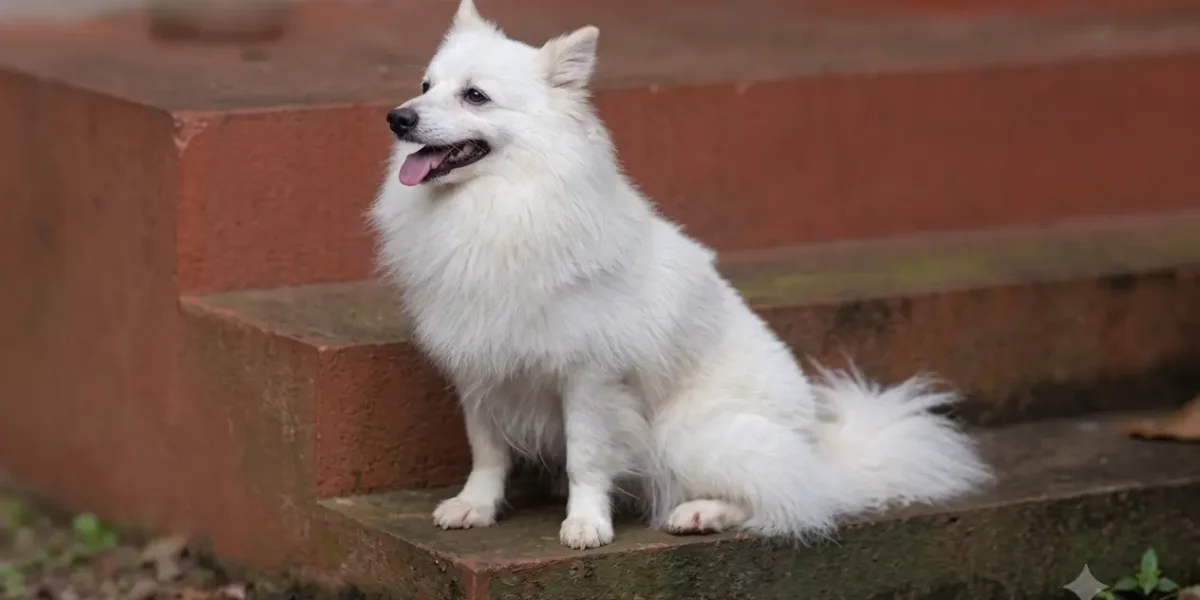
The Indian Spitz is a small to medium-sized companion dog known for its fluffy double coat, pointed ears, curled tail and alert, expressive face. Intelligent, energetic and highly attentive to its surroundings, the Indian Spitz dog became a familiar sight in Indian households during the 1980s and 1990s.
Its manageable size and ability to adapt to different types of homes still make the breed worth considering today. But an Indian Spitz is not a maintenance-free dog. The breed sheds, can be vocal and needs regular exercise, grooming, training and interaction with its family.
It is also frequently confused with the Pomeranian. Despite their similar Spitz appearance, the Indian Spitz and Pomeranian are not simply two names for the same dog.
This guide explains what prospective and current Indian Spitz owners should know before deciding whether this breed fits their lifestyle.
Indian Spitz at a Glance
| Trait | Indian Spitz |
| Origin | Developed in India from Spitz-type ancestry |
| Breed type | Companion / Spitz-type dog |
| Size | Small to medium, depending on variety |
| Common colours | White is most common; brown and other colours can occur |
| Coat | Double coat |
| Shedding | Moderate to heavy, particularly seasonally |
| Temperament | Alert, intelligent, active and family-oriented |
| Exercise needs | Moderate |
| Grooming | Regular brushing required |
| Trainability | Generally responsive with consistent training |
| Apartment living | Possible with adequate exercise and barking management |
| Climate | Adapted over generations to Indian conditions, but still requires protection from extreme heat |
| Best suited for | Families and owners able to provide training, exercise and companionship |
What Is an Indian Spitz?
The Indian Spitz is a Spitz-type dog developed in India from European Spitz ancestry. Historical accounts commonly trace the breed to German Spitz-type dogs brought to India during British rule.
Over time, dogs better suited to local living conditions were bred in India. The breed later became particularly popular when restrictions made imported dogs difficult to obtain during the 1980s and 1990s.
This history is important because descriptions of the Indian Spitz as an ancient indigenous Indian landrace can be misleading. Unlike India’s genuinely native breeds — you can read more about those in our guide to India’s Indie Dogs: Native Dog Breeds of India — the Indian Spitz is better understood as a breed developed and established in India from imported Spitz ancestry.
History and Origin of the Indian Spitz
The history of the Indian Spitz is closely connected with the German Spitz.
Spitz-type dogs are recognised by physical characteristics such as pointed ears, a wedge-shaped or fox-like face, a thick double coat and a tail that curves over the back.
According to the historical account currently documented for the breed, German Spitz-type dogs were introduced to India during British rule. Selective breeding over subsequent generations resulted in dogs increasingly suited to Indian conditions.
The Indian Spitz became especially visible in Indian homes during the 1980s and 1990s. Restrictions on importing foreign dog breeds helped increase demand for dogs already available within the country.
Later, imported Labradors, Golden Retrievers, Pugs, Shih Tzus and other breeds became much more accessible. The Indian Spitz lost some of its earlier popularity, but it never disappeared from Indian homes.
Many Indian families also remember the breed because of Tuffy, the dog featured in the 1994 film Hum Aapke Hain Koun..!. The dog actor, named Redo, was an Indian Spitz.
What Does an Indian Spitz Look Like?
An Indian Spitz has the classic alert appearance associated with Spitz-type dogs.
Common physical characteristics include:
- Pointed, upright ears
- A relatively pointed or conical muzzle
- Bright, expressive eyes
- A fluffy double coat
- A heavily furred tail carried over the back
- Compact but athletic proportions
- Dense fur around the neck and chest
White is the colour most strongly associated with the breed, although brown and other coat variations are also reported.
The coat is one of the breed’s most distinctive features, but it is also responsible for much of the grooming work associated with owning an Indian Spitz.
Indian Spitz Size and Weight
One reason you may find conflicting Indian Spitz size information online is that the breed is commonly described in two size categories.
Lesser Indian Spitz
The smaller variety is often called the Lesser Indian Spitz or Smaller Indian Spitz.
Commonly cited measurements are approximately:
- Height: 22 to 25 cm at the shoulder
- Weight: 5 to 7 kg
Greater Indian Spitz
The larger variety is commonly called the Greater Indian Spitz or Bigger Indian Spitz.
Commonly cited measurements are approximately:
- Height: 35 to 45 cm at the shoulder
- Weight: 12 to 20 kg
These ranges are the ones documented on the existing Indian Spitz reference page.
Individual dogs can fall outside commonly quoted ranges. Age, sex, genetics, body condition and breeding background can all affect adult size. If you’re weighing a bigger dog altogether, our Large Dog Breeds in India guide covers care requirements for larger breeds.
If you are choosing a puppy primarily because you need a certain adult size, looking at both parents is more useful than relying only on what a seller predicts.
Indian Spitz Temperament
A well-socialised Indian Spitz is typically alert, curious and closely aware of what its family is doing.
These dogs are often quick to notice visitors, sounds outside the home or changes in their environment. That alertness can make them useful watchdogs, but it can also become excessive barking if owners encourage every reaction or fail to teach calm behaviour.
Are Indian Spitz dogs affectionate?
Many Indian Spitz dogs form strong relationships with members of their household and enjoy being included in everyday family activities.
However, temperament is never determined by breed alone.
A puppy’s genetics, early socialisation, previous experiences, training and living environment all influence adult behaviour.
Are they intelligent?
Indian Spitz dogs are generally regarded as intelligent and capable learners.
That does not mean every dog will automatically behave well.
An intelligent dog can learn unwanted behaviour just as quickly as desirable behaviour. Consistent boundaries and reward-based training should begin when the puppy comes home.
Do Indian Spitz dogs bark a lot?
They can.
Alert barking is one of the most important practical considerations for anyone living in an apartment.
An Indian Spitz that reacts to lifts, footsteps, doorbells, neighbours or dogs outside a window can become difficult to manage if barking is allowed to develop unchecked.
Early training should focus on teaching the dog what deserves attention and when to settle again.
Is an Indian Spitz a Good Family Dog?
For the right household, yes.
The Indian Spitz’s manageable size, intelligence and social nature can make it a suitable family companion.
But “family-friendly” should never be interpreted as “safe without supervision.”
Children should be taught not to disturb a dog while it is sleeping, eating or trying to move away. Adults should supervise interactions between dogs and young children regardless of breed.
A home that wants a dog involved in daily family life is generally a better match than one where the dog will routinely spend most of the day isolated.
Is an Indian Spitz Good for First-Time Dog Owners?
It can be.
The breed does not require the same physical space as many large dogs, and its exercise requirements are usually manageable for an average household.
However, first-time owners should be prepared for:
- Regular shedding
- Frequent brushing
- Barking management
- Daily walks
- Socialisation
- Basic obedience training
- Veterinary expenses
- Dental and preventive care
- A commitment that can last well over a decade
The small size of a dog does not make ownership a small responsibility.
Can an Indian Spitz Live in an Apartment?
Yes, provided its physical and behavioural needs are met.
Apartment suitability depends less on square footage than many owners assume.
A bored dog in a large house can behave worse than a properly exercised dog in a compact apartment.
For an Indian Spitz living in an apartment, focus on:
- Daily walks
- Indoor play
- Short training sessions
- Puzzle or food-dispensing toys
- Controlled exposure to sounds outside the home
- Teaching a reliable quiet or settle behaviour
- Regular toilet breaks
Barking is likely to be a bigger apartment issue than the dog’s size.
Is the Indian Spitz Suitable for the Indian Climate?
The Indian Spitz developed over generations in India and is generally considered more accustomed to local conditions than some cold-climate breeds kept in the country.
That does not mean an Indian Spitz is immune to heat.
It has a double coat and can still suffer from overheating or heat-related illness.
During hot weather:
- Walk early in the morning or later in the evening
- Avoid intense exercise during hot afternoons
- Keep fresh drinking water available
- Provide shade and ventilation
- Never leave the dog inside a parked car
- Watch for excessive panting, weakness or distress
Climate suitability should not be used as an excuse to exercise a dog during dangerous heat.
Indian Spitz Exercise Requirements
An Indian Spitz does not need hours of intense physical exercise, but it should not live a sedentary lifestyle either.
For most healthy adult dogs, a combination of walks, play and mental activity works better than relying on walking alone.
A typical day might include:
- One or two walks
- Indoor or outdoor play
- Short obedience sessions
- Sniffing opportunities
- Interactive toys
Puppies should not simply be given the adult dog’s exercise schedule. Their activity should match their age and physical development.
Older dogs may also need shorter, more comfortable walks.
Exercise requirements should ultimately be adjusted to the individual dog’s health, body condition and veterinary advice.
Indian Spitz Grooming
The fluffy coat is attractive, but it needs maintenance.
The Indian Spitz has a double coat consisting of an outer layer and an insulating undercoat.
How often should you brush an Indian Spitz?
Regular brushing helps remove loose fur, prevent tangles and reduce the amount of hair deposited around the house.
Most owners will need to brush several times a week, with more frequent grooming during periods of heavy shedding.
Pay particular attention to areas where fur can tangle, including:
- Behind the ears
- Around the neck
- Under the front legs
- Around the hindquarters
- Tail
How often should you bathe an Indian Spitz?
Bathing frequency depends on lifestyle, skin condition and how dirty the dog becomes.
The goal is not to bathe according to an arbitrary calendar.
Over-bathing or using inappropriate products can irritate or dry the skin.
Use a dog-specific shampoo and speak with your veterinarian if your dog develops persistent itching, dandruff, redness, odour or hair loss.
Should you shave an Indian Spitz?
Routine shaving of a healthy double coat is generally unnecessary.
Brushing, de-shedding and appropriate coat care are usually preferable.
If severe matting, skin disease or another medical issue is present, discuss grooming with a veterinarian or experienced professional groomer rather than attempting aggressive clipping at home.
Does an Indian Spitz Shed a Lot?
Yes, shedding is one of the disadvantages prospective owners should understand before bringing one home.
Double-coated dogs naturally lose hair, and the amount can increase during seasonal coat changes.
Wikipedia’s existing breed page also identifies shedding as an important grooming concern for the Indian Spitz.
If having dog hair on clothing, furniture and floors will frustrate you, this may not be the right breed.
Regular brushing can control loose hair, but it will not eliminate shedding completely.
Indian Spitz Food and Diet
There is no special food that every Indian Spitz needs simply because of its breed.
A healthy dog needs a complete and balanced diet appropriate for its age, body size, activity level and health.
Indian Spitz puppy diet
Growing puppies have different nutritional requirements from adult dogs.
Feed an age-appropriate complete puppy diet and follow portion guidance based on your puppy’s body condition and veterinary advice.
Avoid randomly adding calcium, vitamins or other supplements to a nutritionally complete commercial diet unless your veterinarian specifically recommends them.
Adult Indian Spitz diet
For adults, portion control matters.
A fluffy coat can make weight gain harder to notice visually, so owners should regularly monitor body condition rather than judging weight only by appearance.
Treats and table food also count toward daily calorie intake.
Foods dogs should not eat
Common foods that can be dangerous for dogs include chocolate, grapes, raisins, onions, garlic in significant amounts, xylitol-containing products and alcohol.
If your dog eats something potentially toxic, contact a veterinarian rather than waiting for symptoms. And if your dog suddenly goes off its food altogether, our guide on 10 reasons your dog won’t eat walks through the possible causes.
Indian Spitz Training
Training should start as soon as the dog enters your home.
You do not need to wait until an Indian Spitz puppy becomes an adult.
Start with these behaviours
Teach:
- Response to name
- Sit
- Come when called
- Loose-leash walking
- Leave it
- Drop it
- Stay or wait
- Toilet routine
- Calm handling
- Settling quietly
Short, frequent sessions are usually more productive than long repetitive lessons.
Reward the behaviour you want with food, play, attention or access to something the dog values.
Harsh punishment may suppress behaviour temporarily without teaching the dog what to do instead.
How to Stop Excessive Barking in an Indian Spitz
Do not treat every bark as disobedience.
First identify why your dog is barking.
Common triggers include:
- Visitors
- Doorbells
- Other dogs
- People outside the window
- Excitement
- Boredom
- Attention seeking
- Fear
- Being left alone
Then work on the trigger rather than simply shouting at the dog.
For example, if the dog repeatedly barks at activity outside a window, restricting access to that visual trigger while working on calm behaviour may be more effective than repeatedly saying “no.”
Sudden or unusual increases in vocalisation can also have a medical or behavioural cause and deserve professional attention.
Socialising an Indian Spitz Puppy
Socialisation does not mean forcing your puppy to interact with as many strangers and dogs as possible.
Good socialisation means helping the puppy safely experience the world.
That can include:
- Different types of people
- Household sounds
- Traffic sounds
- Veterinary handling
- Grooming
- Car travel
- Different walking surfaces
- Calm dogs
- New environments
Experiences should be controlled and positive.
If a puppy is frightened, forcing an interaction can make the fear worse.
Indian Spitz Health Problems
Reliable breed-specific health data for the Indian Spitz is more limited than for internationally standardised and extensively studied breeds.
That makes exaggerated online lists of “common Indian Spitz diseases” worth treating cautiously.
One published concern specifically associated with Indian Spitz dogs in the existing breed literature is corneal ulceration, an eye condition involving damage to the cornea.
Regardless of breed, Indian Spitz owners should watch for general signs that justify veterinary examination, including:
- Red or painful eyes
- Persistent scratching
- Ear discharge or odour
- Dental problems
- Vomiting or diarrhoea
- Limping
- Unexplained weight change
- Breathing difficulty
- Lethargy
- Changes in appetite or thirst (see our guide on why dogs stop eating if this happens)
Preventive veterinary care, vaccination, parasite control, dental care, spaying or neutering and maintaining a healthy body weight are more useful than assuming a dog will or will not develop disease based only on breed.
Indian Spitz Lifespan
You will find different lifespan figures for the Indian Spitz online.
Current breed guides commonly publish estimates ranging from roughly 10 to 16 years, with 12 to 16 years appearing on several Indian pet-care sites.
These numbers should be treated as approximate rather than as a guarantee.
An individual dog’s lifespan can be affected by genetics, nutrition, body weight, preventive healthcare, accidents, infections and chronic disease.
If you are considering an Indian Spitz puppy, the useful question is not simply “How many years will it live?”
Ask whether you are prepared to care for that dog throughout puppyhood, adulthood and potentially many years of senior care.
Indian Spitz Price in India
There is no official nationwide Indian Spitz puppy price.
Prices advertised online vary considerably according to city, seller, pedigree claims, demand, age and documentation.
Current Indian breed and price guides show advertised ranges starting at only a few thousand rupees and extending beyond ₹20,000 in some cases.
Treat those numbers as market estimates, not fixed breed prices.
More importantly, price is not proof of quality.
An expensive puppy is not automatically healthy or responsibly bred, and an unusually cheap puppy can become extremely expensive if poor breeding or inadequate healthcare results in serious medical problems.
What affects Indian Spitz puppy price?
Factors can include:
- City
- Breeder reputation
- Parentage
- Registration or pedigree documentation
- Veterinary care already provided
- Vaccination and deworming status
- Age
- Demand
- Seller type
Avoid paying substantially more simply because someone advertises a puppy using vague labels such as “premium quality,” “original breed” or “rare colour.”
Those terms alone tell you very little about the dog’s health.
The Real Cost of Owning an Indian Spitz
The purchase price is only a small part of the cost of dog ownership.
You should budget for:
- Complete dog food
- Vaccinations
- Veterinary consultations
- Parasite prevention
- Grooming tools
- Shampoo
- Collar or harness
- Leash
- Bed
- Bowls
- Toys
- Training
- Dental care
- Emergency veterinary treatment
- Boarding or pet sitting when required
A puppy that costs ₹5,000 to acquire can still require many times that amount in responsible care over its lifetime.
Make your decision based on long-term affordability, not the puppy’s selling price.
How to Choose a Healthy Indian Spitz Puppy
Do not choose a puppy because it has the fluffiest coat or whitest colour.
Before buying, ask to see:
- The puppy with its mother when possible
- Living conditions
- Veterinary records
- Vaccination records
- Deworming history
- Information about the parents
- Any available pedigree or registration documents being advertised
Observe whether the puppy appears alert, mobile and comfortable.
Be cautious if you see:
- Eye or nose discharge
- Persistent coughing
- Severe diarrhoea
- Extreme lethargy
- Visible skin disease
- Very dirty living conditions
- Sellers refusing to show the mother
- Multiple breeds being produced continuously in poor conditions
- Pressure to pay immediately
- Claims that vaccination records are unnecessary
A veterinary examination shortly after bringing a puppy home is sensible even if the seller says the dog has already been checked. Once your puppy is settled in, you may also enjoy browsing our list of 300+ Best Indian Dog Names for inspiration.
Indian Spitz vs Pomeranian
One of the most common questions about the breed is whether an Indian Spitz is simply a bigger Pomeranian.
It is not.
The confusion is understandable because both belong to the wider Spitz family and share characteristics such as pointed ears, double coats and tails carried over the back.
However, the modern Pomeranian is a very small Toy breed.
The American Kennel Club lists the Pomeranian at only 3 to 7 pounds, approximately 1.4 to 3.2 kg.
Even the Lesser Indian Spitz is generally heavier.
| Feature | Indian Spitz | Pomeranian |
| General size | Small to medium | Toy |
| Common weight | Approx. 5 to 20 kg depending on variety | 1.4 to 3.2 kg under AKC standard |
| Muzzle | Generally longer and more pointed | Shorter, compact face |
| Ears | Pointed and upright | Small and upright |
| Coat | Double coat | Very profuse double coat |
| Body | More substantial | Compact toy build |
| Apartment suitability | Good with exercise and barking control | Generally good |
| Confusion in India | Frequently called Pomeranian incorrectly | Distinct recognised Toy breed |
Wikipedia’s Indian Spitz article also notes the long-standing tendency in India to refer to Spitz dogs as Pomeranians despite physical differences between them.
How can you tell an Indian Spitz from a Pomeranian?
Size is usually the quickest clue.
A healthy adult Pomeranian conforming to the AKC standard is dramatically smaller than a Greater Indian Spitz and generally smaller than the Lesser variety as well.
Do not rely on fur length or face shape alone, particularly when identifying puppies.
Indian Spitz vs Japanese Spitz
The Japanese Spitz is another white Spitz-type breed that can be confused with the Indian Spitz.
They share:
- White double coats
- Pointed ears
- Curled tails
- Fox-like faces
- Companion-dog temperament
However, they are distinct breed populations with different breed histories and standards.
If pedigree matters to you, appearance alone is not reliable proof of breed identity. Documentation and known parentage are considerably more useful.
Indian Spitz vs German Spitz
This comparison is particularly relevant because the Indian Spitz is widely described as descending from German Spitz stock.
As a result, the breeds naturally share many physical characteristics.
The practical distinction is that the Indian Spitz population developed in India over generations, while German Spitz varieties are governed by their own international breed standards.
This is another reason generic labels such as “Spitz puppy” can create confusion in Indian pet markets.
Always ask exactly what breed the seller claims the dog is and what documentation supports that claim.
Is an Indian Spitz Hypoallergenic?
No dog should be assumed to be truly hypoallergenic.
Indian Spitz dogs shed their coats, which means they are unlikely to suit someone looking specifically for a very low-shedding breed.
Dog allergies are also caused by proteins found in substances such as dander and saliva, not simply by visible hair.
If somebody in your household has significant dog allergies, spending time around the breed before bringing one home is sensible.
Pros and Cons of the Indian Spitz
Advantages
Manageable size Even the larger variety is easier to accommodate than many large breeds.
Intelligent Indian Spitz dogs generally respond well to consistent, reward-based training.
Alert They tend to notice unusual activity quickly.
Adaptable With proper exercise, many can live successfully in apartments as well as larger homes.
Family-oriented Many enjoy staying involved with their household.
Suited to Indian households The breed has been established in India for generations and is generally more practical for local conditions than many extremely cold-adapted breeds.
Disadvantages
Shedding Expect fur around the home.
Barking Without training, alert barking can become excessive.
Regular grooming The coat needs brushing and maintenance.
Needs mental stimulation An intelligent dog with nothing to do can develop unwanted behaviours.
Still requires heat management Being established in India does not make the dog immune to overheating.
Breed identity can be confusing Indian Spitz, Pomeranian, Japanese Spitz and German Spitz labels are frequently mixed up by inexperienced or dishonest sellers.
Who Should Get an Indian Spitz?
An Indian Spitz may suit you if you:
- Want a small to medium companion dog
- Can provide daily walks and play
- Do not mind regular brushing
- Are willing to train barking behaviour
- Want an alert, interactive dog
- Can afford routine and emergency veterinary care
- Want your dog to participate in family life
Who Should Not Get an Indian Spitz?
Think carefully before choosing this breed if you:
- Cannot tolerate shedding
- Want a naturally silent dog
- Will leave the dog alone for extremely long periods every day
- Do not want to groom regularly
- Are unwilling to train your dog
- Expect a pet to stay outdoors permanently
- Cannot budget for veterinary care
- Are choosing the breed purely because puppies appear inexpensive
A cheap purchase price does not make a dog cheap to own.
Should You Buy or Adopt an Indian Spitz?
Buying from a responsible breeder is not the only way to bring an Indian Spitz into your home.
Spitz-type dogs and mixes occasionally appear in rescue organisations, shelters and individual rehoming situations. You can browse dogs currently looking for homes on our adoption page, and our Adopt a Dog page explains how the process works with KAW.
Adoption can be an excellent option, particularly for someone open to an adult dog.
Adult dogs also offer one advantage that puppies do not: much of their final size, coat and temperament is already visible. If you’re not ready to adopt permanently, fostering is a good way to help a dog in the meantime.
If you’re open to a breed developed in India rather than specifically an Indian Spitz, it’s also worth reading why an Indian Pariah dog could be a great fit — you can learn more about the Indian Pariah here.
Whether adopting or purchasing, focus on health, temperament and responsible sourcing rather than appearance alone.
Frequently Asked Questions About the Indian Spitz Dog
No. The Indian Spitz and Pomeranian are distinct dogs. They share Spitz ancestry and some physical characteristics, which is why they are frequently confused in India.
There is no fixed national price. Current online guides and advertisements show a very broad range from a few thousand rupees to more than ₹20,000 depending on location, seller, documentation and other factors. Price should never replace proper health checks.
Yes. An Indian Spitz can live in an apartment if it receives regular exercise, stimulation and training. Barking may be a bigger challenge than space.
Many are naturally alert and vocal. Early training can help prevent normal alert barking from becoming excessive.
Yes. The Indian Spitz has a double coat and sheds. Expect heavier shedding during periods of coat change.
Several brushing sessions each week are useful for most dogs, with more frequent brushing when the coat is shedding heavily.
The breed has been established in India for generations, but it can still overheat. Avoid strenuous activity during the hottest part of the day and always provide water, shade and ventilation.
Indian Spitz dogs are generally intelligent and capable learners. Consistency and positive reinforcement are important because intelligent dogs can also quickly learn unwanted habits.
Many can live successfully with children when properly socialised. Interactions between young children and dogs should always be supervised.
The Lesser Indian Spitz is commonly described at around 5 to 7 kg, while the Greater Indian Spitz may reach roughly 12 to 20 kg. Individual dogs vary.
Published estimates vary, commonly falling somewhere around 10 to 16 years. Health, genetics, preventive care, nutrition, body condition and lifestyle all influence an individual dog’s lifespan.
White is the colour most strongly associated with the Indian Spitz, although brown and other colour variations can occur.
Yes, provided they understand that the breed still requires training, exercise, grooming, socialisation and lifelong veterinary care.
Aggression should not be treated as an expected feature of the breed. Behaviour varies between individual dogs and is influenced by genetics, socialisation, experiences, environment and training.
Regularly leaving any companion dog isolated for very long periods can create welfare and behavioural problems. If your work keeps you away for much of the day, arrange appropriate exercise, toilet breaks and human interaction.
Final Verdict: Is the Indian Spitz a Good Dog?
The Indian Spitz dog remains one of India’s most practical companion breeds for the right owner.
Its moderate size, intelligence, alert personality and adaptability make it suitable for many apartments and family homes. At the same time, prospective owners should not mistake affordability or familiarity for zero maintenance.
An Indian Spitz needs exercise, coat care, training, social interaction and veterinary attention throughout its life. Owners also need to be comfortable managing shedding and potentially frequent barking.
Most importantly, do not choose an Indian Spitz simply because a seller describes it as a cheaper Pomeranian.
Choose the breed because its actual size, personality, grooming requirements and activity level fit your household.
If those characteristics suit your lifestyle, a well-socialised and responsibly cared-for Indian Spitz can be an engaging family companion for many years. And if you’d rather give a home to a dog who’s already waiting for one, take a look at the dogs currently up for adoption with KAW, or get in touch with any questions.