

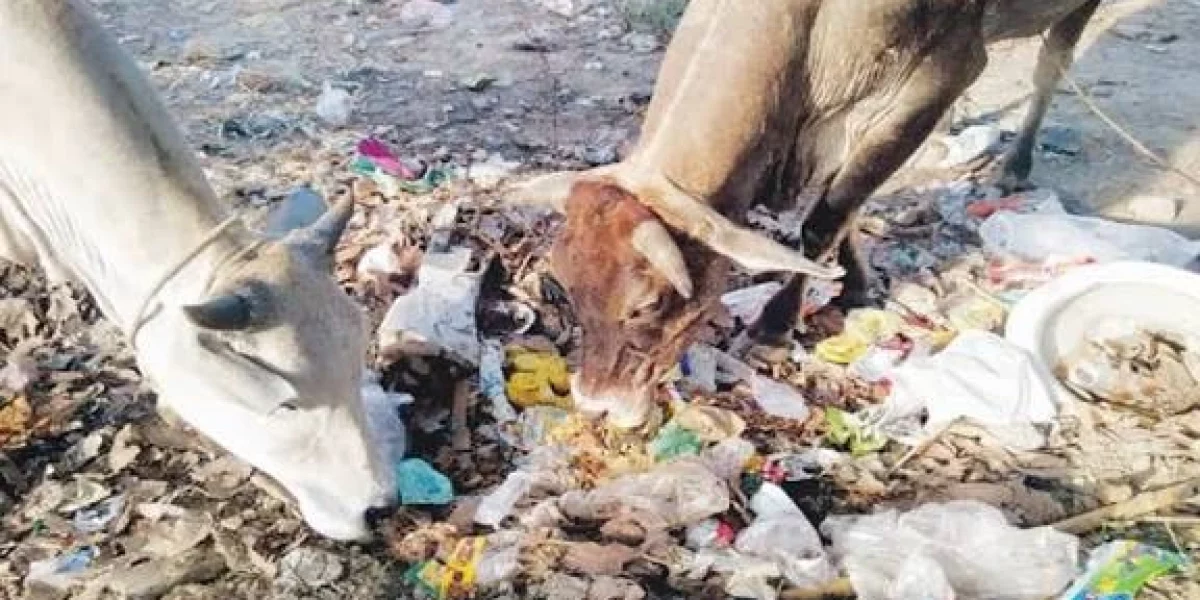
A cow stands at a Delhi garbage point at first light, nosing through a heap of black polythene bags. She is looking for the vegetable peels and stale rotis someone tied up and tossed last night. She cannot untie the knot. So she swallows the bag whole, peels and plastic together, and moves to the next one. By the time anyone notices she is thin under a swollen belly, she may be carrying 30, 50, even 70 kilograms of plastic in her stomach.
This is the quiet machinery behind plastic waste and stray cattle in India. It is not a freak accident. It is a daily, repeating event in every city, and it kills slowly, by starvation, inside an animal that looks well-fed.
At Kannan Animal Welfare (KAW), our rescue work in Delhi-NCR is dogs first. But our team works the same Kapashera garbage points where cattle graze, and the cause of death we keep tracing back is the same one: food waste knotted inside a plastic bag, dumped where any hungry animal can reach it. The cow is simply the animal whose body shows the damage most brutally.
How does plastic waste end up inside stray cattle?
It happens through your kitchen bin, not a factory drain. Most Indian households tie food scraps inside a thin polythene bag before dumping them. A stray cow cannot separate the food from the bag, so she eats both. The plastic stays trapped in her rumen, the largest stomach chamber, building up over months until there is no room left for food.
The rumen is the trap. Veterinary research on ruminal impaction explains why: plastic bags do not pass forward from the rumen into the reticulum and onward through the gut. They sit, knot onto each other, and form a dense, matted ball that hardens over time, as documented in a widely cited study on plastic-related ruminal impaction in the journal Veterinary World. The animal keeps feeling full while slowly starving.
Karuna Society for Animals and Nature, which ran India’s pioneering Plastic Cow Project, found exactly this in surgery after surgery: not just thin carry bags but biscuit wrappers, thicker packaging, iron nails, clips, leather and pins, all knotted into the rumen. In one of their documented cases, 52 kilograms of plastic bags came out of a single cow.
How much plastic does India actually generate?
India generates roughly 4.13 million tonnes of plastic waste a year, the figure the Central Pollution Control Board reported for 2020-21, the highest in its five-year series filed to Parliament. That is the number that ends up on the street, and a share of it ends up in an animal.
To put a date on it: in a written reply in the Rajya Sabha, the Ministry of Environment reported plastic waste generation rising from 3.36 million tonnes in 2018-19 to 4.13 million tonnes in 2020-21, drawing on CPCB annual reports. Delhi-NCR alone accounted for around 345,000 tonnes in that year.
The waste is not the whole problem. The disposal is. When unsegregated wet waste is bagged in polythene and left at an open dumping point, it becomes bait. The smell of food draws cattle, dogs and pigs to the exact place where the plastic is most concentrated. KAW’s team sees this every week around Kapashera: the same bins, the same animals, the same outcome.
What happens inside a cow that eats plastic?
She starves on a full stomach. The plastic mass blocks normal digestion, so even when she eats, almost no nutrition gets absorbed. She loses weight while her belly stays distended, which is why people assume she is healthy or pregnant when she is dying.
The damage is not only mechanical. As the plastic sits in warm rumen fluid for months, it leaches toxins. Karuna Society’s surgeons documented heavy metals and chemical compounds, including lead, cadmium and polychlorinated biphenyls, leaching into the bloodstream from the trapped plastic. So the animal faces two attacks at once: blockage above, slow poisoning below.
Then there is the most cited case in the country. In February 2021, a pregnant cow in Faridabad, Haryana, was rescued after a road accident and operated on. Surgeons pulled out 71 kilograms of plastic, nails and marbles. The calf could not grow for lack of space and died first; three days later the cow died too. Ravi Dubey of People For Animals Trust Faridabad, who has worked in animal rescue for over a decade, called it the most garbage he had ever taken from a cow.
How common is this, really?
It is routine, not rare. In Delhi’s veterinary hospitals, plastic-related cases now make up the majority of cattle surgeries, and surveys of stray cattle have found a large share carrying plastic in the rumen. Vets in several cities describe finding 30 to 50 kilograms of waste as a normal, not exceptional, finding.
Here is a comparison that makes the scale clear.
| Case | Place / Year | Plastic Removed | Outcome |
| Rumenotomy at Veterinary College | Patna, Bihar (2018) | Over 80 kg of polythene removed during a 3-hour surgery | Cow survived; reported as the first 80 kg+ plastic removal case in the surgeon’s 13-year career |
| Pregnant Cow, Post-Accident Surgery | Faridabad, Haryana (2021) | 71 kg of plastic, nails, and marbles removed | Both the cow and her calf died despite surgery |
| Plastic Cow Project Rumenotomy | Karuna Society, Andhra Pradesh | 52 kg of plastic bags removed | Plastic successfully removed through surgery |
Three different states, three different years, and the same wound. This is why treating the plastic waste impact on animals as an occasional viral news story misses the point. The viral cases are simply the ones that got measured.
Why hasn’t the plastic ban fixed this?
Because the ban targets the wrong end of the chain for cattle. India’s 2022 single-use plastic ban prohibited 19 items, mostly straws, cutlery and cotton-bud sticks, and from December 2022 raised the legal thickness for carry bags from 75 to 120 micrometers. None of that addresses the knotted food-waste bag at the neighbourhood bin, which is what cattle actually eat.
The enforcement record makes it worse. Thin carry bags below 120 microns remain the single most circulated banned item, making up close to a third of all banned single-use plastics still in use, going by Centre for Science and Environment tracking of the ban. So the one item most likely to end up in a cow’s rumen is also the one the system is least able to stop.
This is the gap nobody connects. The policy lives at the manufacturing and retail level. The death happens at the household-disposal level. A 120-micron rule does not help a cow if your wet waste still goes out knotted in a bag at the corner dump. The fix that would actually protect stray cattle welfare is duller than any ban: segregate wet waste, never bag food scraps in plastic, and feed strays in a way that keeps them off the garbage points. That is unglamorous, local, and it works.
What can one person actually do?
Change what leaves your own kitchen, then change one bin near you. The chain that kills a cow is short and local, which means it can be broken locally. Three actions, in order of impact.
First, never tie food waste in a plastic bag. Keep a separate wet-waste container, or wrap scraps in paper or newspaper if you must wrap them. A cow can eat a paper-wrapped scrap safely; a polythene-wrapped one can kill her.
Second, feed strays deliberately so they are not driven to the bins. KAW runs a local stray feeding programme precisely because a fed animal does not forage in garbage. An animal that is fed clean food at a fixed spot is an animal that is not swallowing polythene to survive.
Third, report distress early. A cow with a hard, swollen belly and visible weight loss is a surgical emergency, not a healthy stray. If you see an animal in that state in Delhi-NCR, send photos and video to KAW’s team on WhatsApp at +91-9999670042 so our rescue team can guide the next step. Early intervention is the difference between a rumenotomy the animal survives and an autopsy.
FAQs
They are not eating plastic by choice. Stray and abandoned cattle forage in open garbage for food scraps, and because households tie those scraps inside polythene bags, the cow swallows the bag along with the food. She cannot separate the two, and the plastic accumulates in her rumen over months.
Documented surgeries in India have removed 50 to over 80 kilograms of plastic from a single cow’s rumen. A 2018 rumenotomy in Patna removed more than 80 kg in a three-hour operation. These are not outliers; vets in Delhi routinely find 30 to 50 kg.
Not directly. India’s 2022 single-use plastic ban and the 120-micron carry-bag rule target manufacturing and retail, not household food-waste disposal, which is how plastic reaches cattle. Thin banned bags also remain widely in circulation, so the item most dangerous to cattle is still common.
Yes, indirectly. Veterinary research notes that toxins leaching from plastic trapped in the rumen can enter the food chain through milk and meat, which is one reason ruminal plastic impaction is treated as a public-health concern and not only an animal-welfare one.
Look for a hard, distended belly with visible weight loss elsewhere on the body. Treat it as urgent. In Delhi-NCR, message KAW on WhatsApp at +91-9999670042 with clear photos and video so the team can assess whether surgery is needed.
The cheapest rescue is the bag you don’t tie
The hardest part of this story is how preventable it is. No cow needs to carry 70 kilograms of polythene. The plastic in her stomach started as your dinner scraps, knotted in a bag, left where she could reach it. Break that one habit on your street and you remove the single most common cause of a slow, hidden death in India’s stray cattle.
KAW will keep doing the rescue end of this work in Delhi-NCR, the helpline calls, the feeding rounds, the emergencies. But the prevention end belongs to all of us, and it is genuinely small: segregate your wet waste, never bag food in plastic, feed strays clean food away from the bins. If you want to back the work directly, you can donate from India to fund treatment and daily meals, sponsor a meal for the 256 resident and 200-plus street animals KAW feeds every day, or report a case on WhatsApp at +91-9999670042. The bag you choose not to tie tonight is the cheapest animal rescue you will ever perform.