

A community dog collapses in the shade of a parked car, sides heaving, tongue hanging long and flat. That image plays out across thousands of Indian streets every April, May and June. Knowing how to help street dogs in summer in India can be the difference between a dog that pants through the afternoon and one that does not survive it. This guide gives you the vet-backed steps, in the order you will need them.
The heat is not a vague threat. On 26 April 2026, Akola in Maharashtra’s Vidarbha region touched 46.9 degrees Celsius, and on one late-April day every one of the world’s 50 hottest cities sat inside India, according to news coverage of India Meteorological Department data. The IMD’s April-to-June outlook warned of above-normal heatwave days across east, central and northwest India. For a dog with no roof, no fan and no one to fill a bowl, that is a survival problem.
India is home to close to 70 million street dogs, per Humane World for Animals. They cool themselves almost entirely by panting, because dogs sweat only through their paw pads. When the air itself is 45 degrees, panting stops working. That is the gap a feeder, a resident, or a passer-by can close.
Why summer is a killing season for India’s strays
Dehydration and heatstroke are among the leading causes of death for street animals during the hottest months. A street dog faces three compounding problems at once: scarce drinking water as open sources dry up, pavement and concrete that radiate stored heat well into the night, and no air-conditioned room to retreat to. Puppies, pregnant or lactating mothers, elderly dogs and short-muzzled breeds suffer first and worst.
Here is the part most people get wrong. Heat does not only kill at noon. Blacktop keeps releasing heat for hours after sunset, so a dog resting on a road at 9 p.m. can still be lying on a surface far hotter than the air. The danger window in an Indian summer is most of the day and half the night.
Dog heatstroke signs every feeder should recognise
Heatstroke in a dog shows up first as heavy, frantic panting, thick drooling, bright-red gums, and a dog that seeks shade, whines or refuses to move. As it worsens you may see weakness, a wobbly or stumbling walk, vomiting or bloody diarrhoea, confusion, collapse or seizures. These later signs mean a true medical emergency, per Cornell University College of Veterinary Medicine.
Learn this short list by heart, because on a street you will not have a thermometer in the first seconds:
Early warning signs of dog heatstroke
| Sign | What You Will Notice | What It Means |
| Heavy Panting | Fast, open-mouthed breathing with the tongue wide and flat | Dog is struggling to release excess body heat |
| Drooling | Thick, ropey saliva | Early sign of overheating |
| Red or Dark Gums | Gums appear bright red, dark red, or muddy in color | Circulation is under stress |
| Weakness or Stumbling | Wobbly movements, reluctance to stand or walk | Heat is affecting the body’s normal functions |
| Vomiting or Diarrhoea | May occur with or without blood | Medical emergency – contact a vet immediately |
| Collapse or Seizures | Dog collapses, becomes unresponsive, or experiences convulsions | Life-threatening condition – cool the dog and rush to a veterinarian immediately |
A dog with the bottom three signs needs cooling and a veterinarian at the same time, not one after the other.
First aid for an overheated street dog: cool first, then go
If you find a dog in heatstroke, move it into shade and start cooling immediately with cool, not ice-cold, water. Pour or run cool water over the belly, armpits, groin, inner thighs, neck and paws, where blood vessels sit close to the surface, and keep the water moving and fresh. Then add airflow, a fan or even a fast walk through moving air over the wet skin speeds cooling dramatically.
Do not use ice water or ice baths. As counterintuitive as it sounds, very cold water makes the surface blood vessels clamp shut, which traps heat in the core and slows cooling, a point made consistently across veterinary first-aid guidance including the Royal Veterinary College and Cornell.
If you can safely check a rectal temperature, stop active cooling once it falls to around 103 degrees Fahrenheit (39.4 Celsius). Cooling past that point can tip the dog into dangerous hypothermia. No thermometer? Cool until the frantic panting eases and the dog brightens, then stop and get to a vet.
This step matters more than almost anything else you can do. Cooling a dog before it reaches the hospital has been shown to raise survival from roughly 50 percent to around 80 percent, per veterinary emergency guidance. Cool on the spot. Do not save it for the clinic.
For a critically injured or collapsing animal in Delhi-NCR, KAW’s 24×7 emergency helpline on WhatsApp at +91-9999670042 lets you send photos and video so the team can guide you and dispatch help. KAW has run hands-on rescue operations for over 11 years, and its team can advise on cooling and transport while you wait.
Placing water bowls for strays: why terracotta wins
A terracotta or clay water bowl is the single most useful thing you can put outside your gate in summer. The porous mud keeps water meaningfully cooler than steel or plastic through the afternoon, and it does not scald a dog’s tongue the way a sun-baked metal bowl can. A terracotta water bowl for strays costs very little and lasts the season.
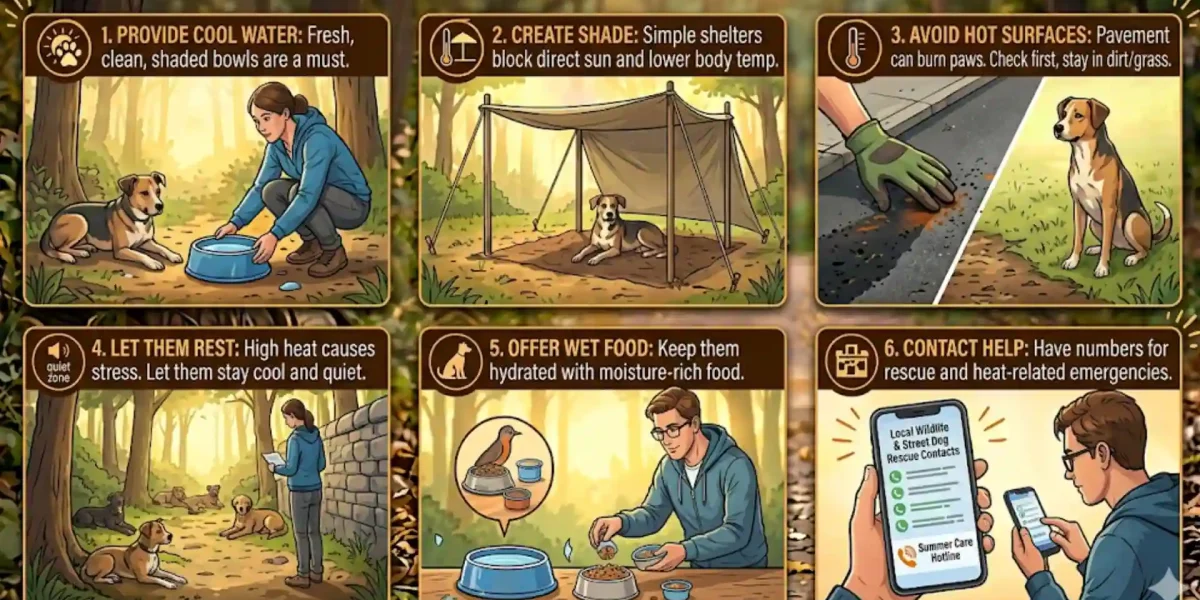
Place it in deep shade, refill it at least twice a day because it evaporates fast, and rinse it so it does not turn into a mosquito tray. Dropping a few ice cubes in is fine and welcome. Do not fill the bowl with extremely chilled water for a dog that is already overheated, as the shock of very cold water can worsen heat stress in a distressed animal.
Spread bowls out. One bowl per street corner serves far more dogs than three bowls outside a single house. If your RWA or apartment block can agree on a handful of shaded clay-bowl stations, you cover a whole colony. This kind of neighbourhood coverage is exactly what large-scale relief looks like: during recent heatwaves, Humane World for Animals reported covering more than a thousand neighbourhoods across Dehradun, Vadodara and Lucknow to keep water and shade within reach of street dogs.
Shade, feeding times and hot-pavement paw burns
Shade is free and life-saving. An old cardboard carton on its side, a jute sack stretched over two bricks, or a tarp lashed to a fence gives a dog somewhere to escape direct sun. Put these in the quiet corners where dogs already sleep by day, not in the middle of foot traffic.
Shift feeding to the cool ends of the day. Food left out at noon spoils within the hour in 44-degree heat and draws flies, and a heat-stressed dog barely eats anyway. Feed at dawn and after dusk. Light, fresh food and plenty of water beat a heavy meal in a heatwave. Frozen treats, watermelon, banana or apple cubes, double as hydration and cooling.
Watch the pavement. There is a simple test from Cornell’s veterinarians: press the back of your hand flat on the road for ten seconds. If you cannot hold it there, it is too hot for a dog’s paws. Burned pads show up as limping, licking at the feet, or raw, peeling skin. If you find paw burns, gently wash the paws with mild antibacterial soap, rinse thoroughly, keep the dog off hot surfaces, and seek veterinary help for anything beyond a mild redness.
Puppies and nursing mothers: the highest-risk group
Puppies, pregnant dogs and lactating mothers dehydrate faster than healthy adult dogs and tip into heat distress sooner, so they deserve your first attention. A nursing mother is feeding a litter and losing fluid in 45-degree heat at the same time, a brutal combination.
If you are feeding a colony, prioritise these dogs. Keep a shaded, refilled water source within a few steps of any den you know holds puppies, because a young pup cannot travel far to drink. Add extra food for a nursing mother. If you find a litter that looks limp, unresponsive or abandoned in the open sun, treat it as an emergency, move them to shade, offer water, and call a rescue helpline straight away. Sterilisation is the long game that shrinks the number of vulnerable summer litters in the first place, the humane and lasting fix that groups like KAW pursue through their spay and neuter work.
What KAW’s helpline does in a heat emergency
KAW, the Kannan Animal Welfare sanctuary based in Kapashera, Delhi, feeds 256 resident animals and more than 200 street animals every single day, and runs a 24×7 emergency line built for exactly these calls. When you message the helpline with photos of a collapsed or burned dog, the team assesses severity, talks you through immediate cooling or wound care, and arranges rescue and transport to treatment for critical cases across Delhi-NCR.
In a heatwave, that triage matters. Not every overheated dog needs to be moved, sometimes shade and water on the spot are enough, and a calm voice on WhatsApp telling you which it is prevents both panic and neglect. KAW pairs this emergency response with year-round local stray feeding and medical care, so the summer push sits on top of an existing network rather than starting cold each April.
Quick-reference: do and don’t in extreme heat
Helping street dogs in extreme heat, fast reference
| Do | Don’t |
| Put out terracotta water bowls in deep shade | Don’t use sun-baked metal bowls in direct sunlight |
| Refill water at least twice daily | Don’t let bowls run dry or become breeding grounds for mosquitoes |
| Cool an overheated dog with cool water on the belly and paws | Don’t pour ice-cold water or use ice baths |
| Feed dogs at dawn and dusk when temperatures are lower | Don’t leave food out at noon where it can spoil in the heat |
| Do the 10-second pavement hand test before walks | Don’t walk or move a dog across scorching hot pavement or tarmac |
| Call a rescue helpline if a dog collapses, suffers burns, or if a litter is in distress | Don’t wait and watch a dog showing signs of true heatstroke |
FAQs
Put one terracotta bowl of cool water in deep shade outside your gate and refill it morning and evening. That single habit, multiplied across a street, keeps a colony hydrated through a heatwave. Add a frozen watermelon cube or two and you have done more than most.
Heavy, frantic panting, thick drooling, bright-red gums and a dog seeking shade or refusing to move are the early dog heatstroke signs. Weakness, stumbling, vomiting, collapse or seizures mean a life-threatening emergency, cool the dog at once and get a veterinarian.
No. Use cool, not ice-cold, water on the belly, armpits, groin and paws, and add a fan or moving air. Very cold water and ice baths constrict surface blood vessels and trap heat in the core, slowing cooling. A few ice cubes in a drinking bowl, however, are fine.
Porous clay keeps water cooler for longer than steel or plastic in direct sun, and it never heats up enough to scald a dog’s tongue. A terracotta water bowl for strays is cheap, refillable and lasts the whole summer.
Press the back of your hand flat on the road for ten seconds. If you cannot keep it there, it is too hot for paws and can cause burns. Move dogs onto grass, mud or shade, and check for limping or raw, peeling pads.
Message KAW’s 24×7 helpline on WhatsApp at +91-9999670042 with photos and video of the animal. The team will guide you on cooling and first aid and arrange rescue for critical cases.
The bowl you fill today is the difference
Helping strays survive an Indian summer is not heroic, mostly. It is a clay bowl refilled twice a day, a cardboard box turned into shade, a feeding shifted to dawn, and the sense to cool a collapsing dog with cool water before anything else. Do those small things on your street and you will carry a colony through the worst months. When a case is beyond first aid, a burned litter, a dog down and seizing, that is when KAW’s network steps in.
If you cannot be on the street every day, you can still keep the bowls full and the rescue vans running. Sponsor a meal or support KAW’s stray-feeding and rescue work, and report any animal in distress in Delhi-NCR on the 24×7 WhatsApp helpline at +91-9999670042. This summer, that is how you help street dogs beat the heat.