

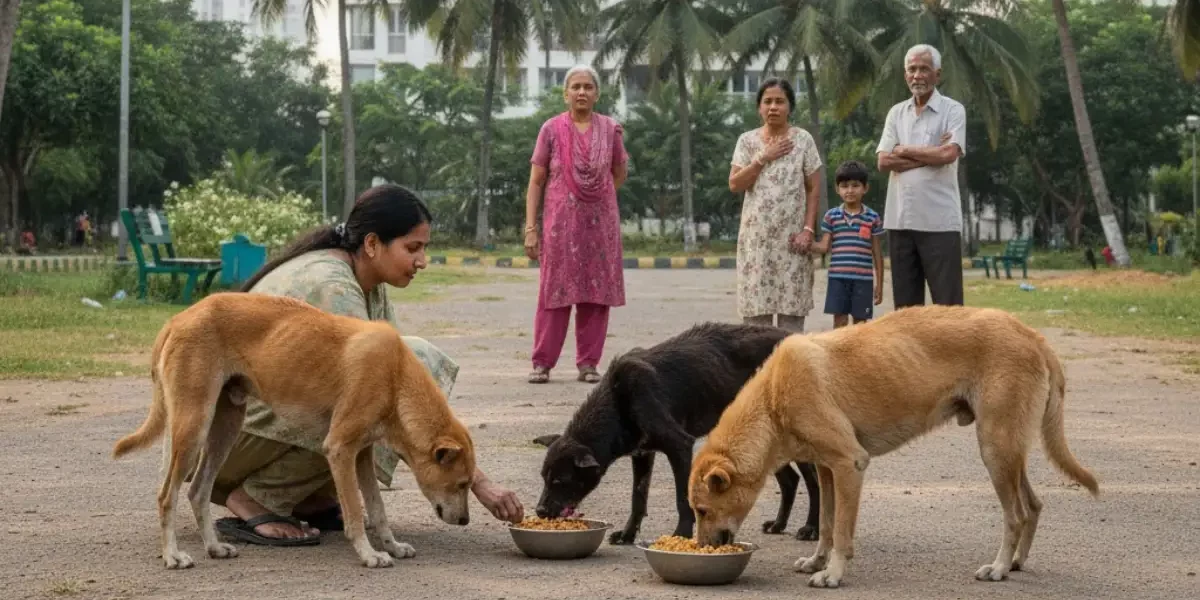
Few topics have been discussed as widely in India recently as the Supreme Court stray dog order. News headlines, social media debates and neighbourhood arguments have left many people confused. Is feeding still allowed? Can stray dogs be removed? What happens to sterilised dogs?
This issue involves two real concerns: public safety, including dog bites and rabies, and the welfare and rights of animals. The Court has been trying to balance both.
In this blog, we explain the key directions of the stray dog verdict 2026 in simple language, what they mean for feeders and residents, and how you can help dogs responsibly. Please note that the case is ongoing, so always check the latest court updates.
1. Why the Supreme Court Is Hearing the Stray Dog Case
The issue reached the highest court because of concerns about dog bites, rabies and the safety of people in public places. Submissions recorded in the Court’s judgment note that India’s stray dog population has grown from about 2.5 crore in the early 2000s to nearly 8 crore today.
At the same time, animal welfare groups point out that mass removal does not control rabies, and that dogs are living beings that deserve humane treatment. The Court has been working to reconcile these two positions.
2. What the Supreme Court Stray Dog Order Says
The Court’s directions have come in stages, with a major order in November 2025 and a detailed judgment in 2026. The main points are:
- Stray dogs are to be shifted from places such as educational institutions, hospitals and railway stations to designated shelters after sterilisation and vaccination.
- Dogs picked up from these areas are not to be released back to the same location.
- The 2026 verdict ordered the rounding up, sterilisation and permanent relocation of stray dogs from key public areas such as hospitals, schools, bus stands and railway stations.
- The Court issued binding directions applicable to all States, Union Territories and the National Highways Authority of India (NHAI).
Court cases keep evolving, so please treat this as a general summary and not as legal advice.
3. Stray Dogs in Institutional Areas: What Changes
“Institutional areas” means places like schools, colleges, hospitals, sports complexes, bus stands and railway stations. In these places, the Court has prioritised safety because many vulnerable people gather there.
In practice, this means:
- Dogs in these premises are to be captured, sterilised, vaccinated and moved to shelters.
- They are not meant to be returned to the same institutional premises.
- Institutions are expected to take steps to prevent dogs from re-entering, such as better waste management and secure boundaries.
This has created a major need for safe shelter space, which is where animal welfare organisations and the public can step in.
4. Highways and the NHAI Question
The Court has also addressed stray animals on national highways, where accidents can be fatal for both animals and people. In a recent development, the Court has placed responsibility on both NHAI and state authorities, and has suggested that NHAI contribute towards shelters through its CSR funds.
The key message is that road safety and animal welfare are shared responsibilities of authorities, not just individuals.
5. Euthanasia and ABC Rules India
Two points cause the most confusion: euthanasia and the Animal Birth Control (ABC) Rules.
Euthanasia: The Court has clarified that outside a few specific situations, euthanasia remains impermissible. A resident’s complaint about a dog, without evidence of aggression or disease, does not justify it. In other words, dogs cannot be killed simply because someone complains.
ABC rules India: The ABC Rules, 2023 generally say sterilised dogs should be returned to their locality. The Court has held that its directions for institutional areas do not violate this provision. Legal analysts explain that the order suspends the return-to-territory rule only inside a specific class of public places. Outside those places, the sterilise-vaccinate-return approach remains the broader framework.
6. What It Means for Feeders
The Supreme Court stray dog order does not ban feeding. But if you feed community dogs, you should:
- Avoid feeding inside institutional premises such as schools, hospitals and stations.
- Use designated feeding spots where available.
- Keep feeding areas clean and feed at fixed times.
- Work with your RWA or local authority to find suitable locations.
- Keep the dogs you feed vaccinated and sterilised.
Read our guide to feeding stray dogs rules in India to understand feeder rights and responsibilities in more detail.
7. What It Means for Residents and Communities
If you are worried about stray dogs in your area, here is what to do about stray dogs safely and humanely:
- Report aggressive, sick or injured dogs to your municipal body or a rescue organisation instead of taking matters into your own hands.
- Avoid teasing, chasing or hitting dogs, which often leads to bites.
- Teach children to stay calm around dogs and not to approach unfamiliar ones.
- Seek medical attention and a rabies vaccine immediately after any bite.
- Support sterilisation and vaccination drives in your locality.
Cooperation between residents, feeders and authorities solves problems far better than conflict.
8. How You Can Help Dogs Right Now
The orders have increased the demand for shelter space, food and medical care. You can help by:
- Adopting a dog or fostering a rescued dog.
- Supporting spay and neuter programmes.
- Sponsoring meals or donating towards shelter care.
- Following credible updates, such as the analysis on the Supreme Court Observer.
For official guidance on feeding and care, you can also visit the Animal Welfare Board of India.
Even small steps strengthen the humane, long-term solution of sterilisation, vaccination and adoption.
How Kannan Animal Welfare Helps Dogs in Need
Kannan Animal Welfare rescues, treats, sterilises and rehomes dogs across Delhi-NCR, providing a stray dog shelter for animals that need protection and long-term care. Its rescue operations team supports injured and critically ill animals, showing how sterilisation, medical care and adoption together offer a practical way forward.
Community support is vital at a time when shelters are under pressure. You can help by donating from India and supporting dogs in need. Donations are eligible for tax benefits under 80G.
Frequently Asked Questions
It is a set of directions that, among other things, require stray dogs in institutional areas such as schools, hospitals and railway stations to be sterilised, vaccinated and moved to shelters, not released back to the same spot.
No. Feeding is not banned, but it should be done responsibly, at designated spots and not inside institutional premises.
No. Euthanasia is allowed only in very limited situations, and a resident’s complaint alone is not enough.
Yes. The ABC Rules remain the broader framework, with the Court’s directions creating an exception for institutional and certain public areas.
Report aggressive or injured dogs to authorities or a rescue organisation, avoid harming animals, support sterilisation and vaccination, and consider adoption or fostering.
Conclusion
The Supreme Court stray dog order reflects a difficult balance between human safety and animal welfare. While the legal position will keep evolving, one thing is clear: lasting solutions lie in sterilisation, vaccination, responsible feeding, shelters and adoption, not in cruelty or neglect.
Every citizen can contribute to a safer, more humane community. Support organisations like Kannan Animal Welfare, adopt or foster if you can, and speak up for compassion in your neighbourhood.