

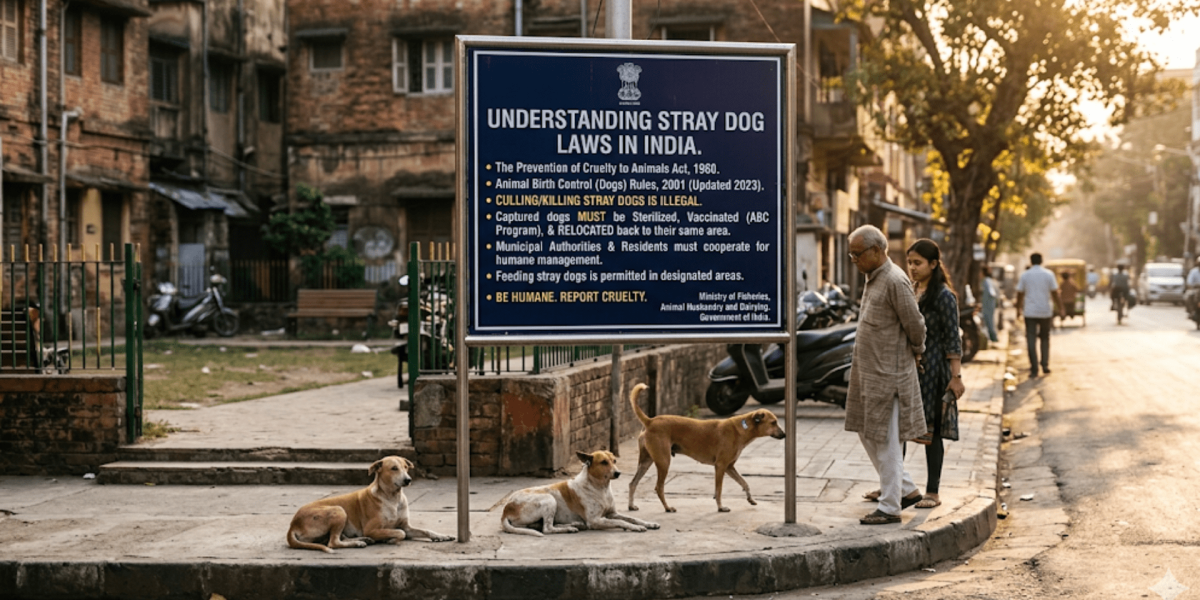
Attacks by stray dogs are no longer local news. In Indian cities, such cases are now igniting popular furore, judicial proceedings, and policy discussions that can no longer be swept under the carpet. The figures are increasing, the fights are becoming more ugly and somewhere in the midst of all this mess, the dog policy in India is at a crossroads that needs immediate action. Organisations such as Kannan Animal Welfare (KAW), established by Vandana Anchalia in Delhi NCR, have not waited until the system catches up. Their teams are already out there doing what must be done, rain or shine.
Understanding India’s Current Dog Policy Framework
India’s dog policy draws its legal backbone from the Animal Birth Control (ABC) Rules, set under the Prevention of Cruelty to Animals Act. At its core, the law shuts the door on culling or relocating stray dogs as a population control measure, full stop. This is a position the Supreme Court of India has come back to time and again, each time sending a firm message that humane treatment is the only path forward. Responsibility for putting these dog rules and regulations into practice falls on the Animal Welfare Board of India (AWBI) and municipal bodies spread across the country.
But here is where things get uncomfortable. The dog ownership policy may read well on paper, yet the streets paint a completely different picture on most days. KAW’s 24×7 emergency helpline at +91-9599099323 does not ring quietly. Dogs hit by speeding vehicles, animals beaten and left to bleed, creatures suffering without a soul in sight, these calls pour in daily, and the team picks up every single time.
Key Policy Changes and Updates in Recent Years
The increasing strain of urban stray populations and a sequence of high-profile attack incidents have put the dog policy debate in India into the limelight. The manner in which the dog management policy is being drafted, amended and put into practice on the ground today has compelled the courts, municipalities and lawmakers to sit up and take a closer look at the manner in which the policy is being drafted, amended and put into practice on the ground today. These are some of the most significant changes that have occurred in the last several years.
- The Supreme Court stepped in to restore the ABC Rules, and all local governments were warned that humane stray dog control is not an option, but a legal requirement.
- Some cities adopted new city policies that eliminated certain stray dog feeding zones, bringing some sanity to what was previously a chaotic and controversial practice.
- Housing societies and RWAs have come under an updated pet policy for dogs, finally giving residents and associations a clearer rulebook to refer to when disputes arise.
- Compulsory microchipping of pet dogs has been gaining serious traction as a proposal, and KAW has been walking the talk through its own active microchipping programme long before it became a talking point.
- Enforcement of dog management policy continues to be a patchwork affair, with stark differences in how seriously different states take their responsibilities.
- The native Indian Pariah dog is slowly earning recognition within formal adoption frameworks, and KAW deserves real credit for pushing this conversation since its earliest days.
Challenges in Implementing Dog Policy on the Ground
Ask anyone working in animal welfare, and they will tell you the same thing. Dog policy as written and dog policy as lived are two entirely separate realities in this country. Municipal budgets are stretched thin, sterilization facilities are either scarce or poorly run, and getting communities to accept humane management over quick fixes remains an uphill battle in most parts of India. Dog rules and regulations also get applied so differently from one state to the next that the animal’s fate often depends more on geography than on the law.
The ground-level data that KAW encounters daily makes all of this painfully concrete. Roughly two-thirds of street-born puppies do not cross the three-month mark, and barely one in ten survives to see their first birthday. These are not background statistics for a report. They are the reason KAW crews are loading injured animals into vehicles at odd hours every day, running between their Sohna sanctuary and Noida medical unit, plugging the gaps that no policy document has yet managed to close.
The Role of Animal Welfare NGOs, with a Spotlight on KAW
Where the dog policy stops delivering, NGOs step in and carry the weight. Across India, these organisations function as the real-world arms of a legal framework that often cannot enforce itself. Of all the groups doing this work with consistency and depth, Kannan Animal Welfare occupies a place that is genuinely hard to match.
Vandana Anchalia has quit her fourteen-year career in the corporate world due to the refusal to believe that animals that are being rescued should not have less than decent and decent treatment. That norm became the DNA of KAW, and it still determines all the decisions that the organisation makes today. This is what it would look like in practice.
- KAW operates a full-time sanctuary in Sohna and a medical unit in Noida, which do all the work, including late-night emergency rescues, to months-long rehabilitation of animals requiring months of care before they can be adopted.
- Sterilization camps, regular feeding routes across Delhi NCR, vaccination drives, and rehoming programmes together form KAW’s on-ground answer to what dog policy requires, but municipal bodies routinely fall short of delivering.
- More than 100 dogs have found permanent homes abroad through KAW’s international adoption pipeline, built in collaboration with organisations such as Operation Paws for Homes (OPH), placing them among a very small group of Indian NGOs operating at this level.
- With 12A and 80G recognition in India and a registered 501(c)(3) status in the USA, every rupee or dollar donated to KAW carries both accountability and tax advantage, on whichever side of the world the donor sits.
What Responsible Dog Ownership Looks Like Today
Responsible dog ownership today is both a legal obligation and a moral one under India’s evolving dog policy. If you are a pet owner or someone who cares about the animals in your neighbourhood, here is what showing up for them actually looks like.
- Get your pet registered and microchipped today, a step KAW’s microchipping programme has been nudging Delhi NCR pet owners toward for years now.
- Learn your housing society’s pet policy for dogs and keep yourself current with whatever RWA guidelines apply where you live.
- Stick to your sterilization and vaccination schedule without delay, because each lapse has consequences that ripple well beyond your own front door.
- Abandoning a pet is never the answer, not under any pressure or circumstance. Call an NGO like KAW before you consider walking away.
- Get behind sterilization drives running in your area, whether that means showing up, chipping in, or just telling five more people that it is happening.
- Animal cruelty demands a response, not silence. Call KAW’s helpline at +91-9599099323 or reach them on WhatsApp at +91-9999670042, because your single report could be what stands between that animal and the worst.
How Citizens Can Support Stray Dog Policy Implementation in India
Stray dog policy in India does not succeed through legislation alone. It depends heavily on responsible participation from citizens and communities. Here are simple but powerful ways individuals can contribute to humane stray dog management:
- Report injured or abused stray animals immediately to local rescue teams or animal welfare NGOs
- Support sterilization and vaccination drives happening in your neighbourhood
- Choose adoption instead of buying pets, especially native Indian breeds like the Indian Pariah dog
- Avoid relocating community dogs, as relocation is illegal under ABC Rules and disrupts territorial balance
- Collaborate with trusted animal welfare organisations like Kannan Animal Welfare through volunteering, donations, or awareness sharing
Even small actions at the community level help strengthen the implementation of stray dog policy across India.
Conclusion
India’s dog policy is heading somewhere better, and that progress is real and worth saying out loud. But legislation sitting in court files has never once bandaged a dog or pulled one off a highway at 2 AM. That takes people, and it takes organisations like Kannan Animal Welfare, with Vandana Anchalia at the helm, converting what policy intends into what actually happens on the streets of Delhi NCR, day after relentless day.
If something in this blog stayed with you, let that feeling turn into something real. Head over to kannananimalwelfare.org and adopt, donate, volunteer, sponsor a meal, or simply pass KAW’s work along to someone who gives a damn. When a life is genuinely on the line, no action is ever too small to matter.
FAQs
Yes. Courts in India have repeatedly affirmed that citizens have the right to feed stray dogs, provided it does not create public safety risks and is done responsibly.
No. RWAs cannot impose blanket bans on pet ownership. However, they may create reasonable guidelines for hygiene, safety, and shared spaces.
Contact a local animal welfare NGO or rescue helpline immediately. Quick reporting improves survival chances significantly.
Yes. Pet abandonment qualifies as cruelty under the Prevention of Cruelty to Animals Act.
Support sterilization drives, adopt Indian native breeds, vaccinate community dogs, and report cruelty cases responsibly.
The Animal Birth Control Rules 2023 strengthen guidelines around sterilization, vaccination, feeding rights, and responsibilities of municipal authorities toward humane stray dog management.