

The phone calls KAW every monsoon follow a pattern. A society in Gurugram counts eleven puppies behind Block C in March. By August it was twenty-three dogs, a bite complaint, and an RWA WhatsApp group at war. Someone always suggests the same thing: load them into a van and drop them somewhere else. It feels decisive. It is also illegal, and it makes the exact problem it is meant to solve worse.
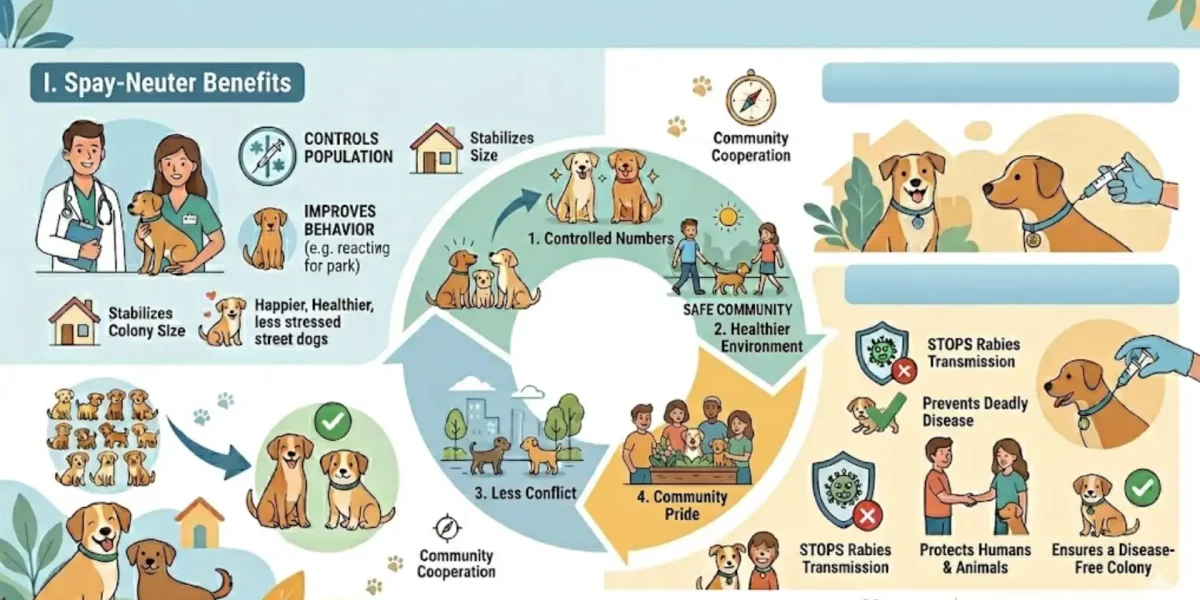
If you feed, manage, or live alongside community dogs, the single most useful thing to understand is this: a well-run animal birth control program in India does not just shrink the dog population over time. It keeps the colony on your street stable, vaccinated, and far less likely to bite. This is the core of how the ABC-AR program works, and why every credible authority in India now treats sterilise-plus-vaccinate as the only legal and effective approach.
This guide explains what the ABC (Animal Birth Control) Rules, 2023 actually require, the science behind why removal backfires, India’s staggering rabies burden and the Rabies-Free 2030 goal, and exactly where a Resident Welfare Association’s responsibilities begin and end.
What does an animal birth control program in India actually do?
An animal birth control program in India catches free-roaming dogs, sterilises and vaccinates them against rabies, lets them recover, and returns each dog to the precise spot it was picked up from. It is run by the local municipal body, often through an Animal Welfare Board of India (AWBI) recognised organisation. The aim is a population that stops breeding, carries immunity, and stays put.
That last part — returns to the same spot — is not a sentimental detail. It is the engineering that makes the whole system work. A sterilised dog cannot add to the population, a vaccinated dog cannot carry rabies, and a returned dog holds its territory so an unvaccinated stranger cannot move in. This combined model is what professionals mean by an ABC-AR program: Animal Birth Control paired with Anti-Rabies vaccination, delivered together in one catch.
KAW has run exactly this kind of spay-neuter work across Delhi-NCR for over eleven years, conducting low-cost surgeries, pre-operative blood tests, and full post-operative care before releasing each community animal back to its caretakers.
What do the ABC (Animal Birth Control) Rules, 2023 require?
The Animal Birth Control Rules, 2023 were notified by the Central Government on 10 March 2023 under the Prevention of Cruelty to Animals Act, 1960, replacing the older 2001 rules. They are the binding legal framework for every street-dog decision in the country.
The core requirements
Local bodies own the program. Municipal corporations and panchayats are legally responsible for the deworming, sterilisation and immunisation of street dogs. They may engage an AWBI-recognised Animal Welfare Organisation to carry it out, but the duty sits with the local authority.
Rabies vaccination is mandatory. Every dog passing through an ABC program must be vaccinated against rabies. Sterilisation without the anti-rabies shot is not compliance.
Dogs return to their original location. Rule 11 requires that, once sterilised and immunised, a dog is released back to the same locality it came from. The rule-makers wrote this deliberately — it prevents shelter overcrowding and keeps the dog in the environment it already knows.
Relocation is prohibited. The Supreme Court has repeatedly held that community dogs cannot be relocated. Picking up dogs and dumping them in another ward is not a grey area; it is a violation.
Sick or aggressive dogs get treatment, not exile. A dog that is genuinely aggressive or suspected rabid is handed to an Animal Welfare Organisation for observation and treatment, then returned once recovered — not removed permanently.
Centres need real infrastructure. Each ABC centre must have kennels, transport vans, mobile operating theatres, incinerators and CCTV, with monitoring committees at central, state and local levels.
In August 2025, the Supreme Court reinforced this framework, modifying an earlier order to direct that picked-up stray dogs be released back after sterilisation and vaccination, except those that are rabid or demonstrably aggressive. The legal direction is consistent and clear: vaccinate, sterilise, return.
Why sterilise-and-vaccinate beats removal: the vacuum effect
Here is the part most residents have never been told. Removing dogs from a territory does not empty it — it refills it with worse dogs.
When a colony of resident dogs is taken away, the food, water and shelter that supported them are still there. Dogs from surrounding areas move in to claim the vacancy. Biologists call this the vacuum effect, and it is the reason mass culling and relocation have failed to reduce stray populations or disease anywhere they have been tried.
The rabies maths makes it concrete. Imagine a street with 100 dogs where 70 are vaccinated and 30 are not — that 70% coverage is the threshold the World Health Organization sets for herd immunity. Now remove 50 of the vaccinated, settled dogs and let 50 unvaccinated newcomers drift in. Your ratio flips from 70-vaccinated to roughly 20-vaccinated and 80-unvaccinated. You have not made the street safer. You have manufactured a rabies-vulnerable population and dissolved the immunity that protected residents.
A sterilised, vaccinated resident dog does the opposite of all this. It does not breed, so the count falls year on year. It carries rabies immunity. And because dogs are territorial, it actively guards its patch against unvaccinated intruders. Sterilisation also lowers population turnover, which means each vaccination dose protects the colony for longer. Settled, fixed dogs are calmer, less prone to mating-season aggression and territorial fighting, and easier for an RWA to live alongside.
This is why the benefits of sterilizing strays are public-health benefits, not just animal-welfare ones. A stable vaccinated colony is a wall between rabies and your residents.
India’s rabies burden and the Rabies-Free India 2030 goal
India carries the heaviest rabies burden on Earth. The country records an estimated 18,000 to 20,000 human rabies deaths every year — close to 36% of the global total — for a disease that is 100% vaccine-preventable. Around 96% of those deaths trace back to dog bites, across an estimated stray-dog population in the tens of millions.
This is what the national strategy is built to end. On World Rabies Day in 2021, India launched the National Action Plan for Dog Mediated Rabies Elimination (NAPRE), targeting zero human rabies deaths by 2030. It runs under the National Rabies Control Programme (NRCP) and aligns with the global “Zero by 30” goal set by the WHO and partners — the worldwide push to eliminate dog-mediated human rabies deaths by 2030.
A Rabies-Free India 2030 is not achievable through hospital treatment alone. It depends on getting and keeping at least 70% of dogs vaccinated — and the only durable way to hold that 70% across a moving, breeding population is the ABC-AR program. Every dog KAW sterilises and vaccinates is one more brick in that 70% wall.
How an ABC-AR program runs, step by step
A single dog moves through an ABC-AR cycle in roughly four stages:
Stage | What happens | Who is involved
Catch | Trained catchers humanely net the dog; feeders point out which dogs and help reduce stress | Municipal/NGO team + feeders
Surgery & vaccination | Pre-op blood test, sterilisation surgery, and the anti-rabies shot in the same visit | Veterinary team
Recovery | Post-operative monitoring; the dog is housed until the wound heals | NGO/clinic
Return & aftercare | The dog is released to the exact pickup spot, often ear-notched to mark it as done; feeders monitor and feed | NGO + feeders/caretakers
The feeder is not a bystander in this. Feeders know which dogs are un-sterilised, can identify them by sight, and calm them during the catch. KAW’s spay-neuter program explicitly asks caretakers to help catch their community dogs and to keep them well-fed and watched for several days after release. An ABC program without local feeders is slow and stressful; one with them is fast and humane.
What an RWA can and cannot do — legally
This is where most colony conflicts ignite, so it is worth stating plainly. Under the ABC Rules, 2023, an RWA or Apartment Owners’ Association has real authority over logistics and none over the dogs’ right to remain.
An RWA can: designate where and when community dogs are fed, set up agreed feeding points away from children’s play areas and building entrances, and request the municipal body to run an ABC drive in the colony. Channelling feeding to fixed spots and times is a legitimate, useful power.
An RWA cannot: ban feeding, threaten or penalise feeders, or have dogs removed or relocated from the premises. Those acts are illegal under the ABC Rules and the wider abc rules stray dogs framework, and can attract action under animal-cruelty law. Where disputes harden, a joint committee with municipal officials and animal-welfare representatives can be formed to issue a binding decision.
The fastest route out of an RWA dog conflict is almost never removal — which is illegal and triggers the vacuum effect — but a sterilisation drive that caps the population and a designated feeding plan that reduces friction. KAW’s recent work has leaned hard into exactly this, with 2026 guidance for societies on the law around feeding and on defusing RWA-versus-feeder standoffs before they reach a complaint.
How KAW’s spay-neuter work fits in
KAW’s spay-neuter program delivers the unglamorous middle of all this: the surgeries themselves. The KAW veterinary team runs pre-operative health checks and blood tests, performs the sterilisation, vaccinates, provides full post-operative care, and returns each animal to its territory and its feeders — the ABC-AR cycle done properly, dog by dog. Alongside the surgeries, KAW runs rescue operations for critically injured and sick street animals across Delhi-NCR, feeds 200-plus street animals daily through its Virtual Parents Program, and rehomes dogs in India and overseas.
For a feeder or an RWA, the practical takeaway is simple. You do not have to win an argument about whether dogs belong on your street — the law has settled that. You have to get the dogs on your street sterilised and vaccinated, and keep them there. That is the whole game.
If your colony needs a sterilisation drive, or you are managing a stray-dog situation in Delhi-NCR, contact Kannan Animal Welfare. Support a spay-neuter surgery, sponsor a meal, or report a case on the 24×7 helpline at +91-9999670042. Every fixed, vaccinated dog returned to its street is one fewer litter, one less rabies risk, and one safer colony.
FAQs
No. The Animal Birth Control Rules, 2023 and repeated Supreme Court orders prohibit relocating community dogs. Sterilised, vaccinated dogs must be returned to the same location they were picked up from. The only legal route to a smaller, calmer dog population is an ABC sterilisation drive, not removal.
Yes. Sterilised dogs do not breed, so the population falls over time, and the anti-rabies vaccination given during the same procedure builds herd immunity. Settled, fixed dogs are also less aggressive and territorial. A stable vaccinated colony lowers both bite incidents and rabies risk.
The local municipal body or panchayat is legally responsible under the ABC Rules, 2023. It can engage an AWBI-recognised animal welfare organisation, such as KAW in Delhi-NCR, to carry out the catching, surgery, vaccination and return.
No. An RWA cannot ban feeding or penalise feeders. It can designate specific feeding spots and times to reduce conflict, but it cannot remove the dogs or the feeders’ right to feed them at agreed points.
It is India’s target, under the National Action Plan for Dog Mediated Rabies Elimination launched in 2021, to reach zero human rabies deaths by 2030 — aligned with the global WHO “Zero by 30” initiative. Mass dog vaccination, sustained through ABC programs, is central to reaching it.
Contact a local AWBI-recognised organisation or your municipal body’s ABC cell. In Delhi-NCR, you can reach Kannan Animal Welfare to arrange spay-neuter surgery; feeders are asked to help identify and gently catch the dogs and to monitor them after release.